That "AI Chatbot" on Your Website Might Not Be What You Think
Here's a stat that might surprise you: nearly 60% of customers who interact with a basic chatbot end up more frustrated than when they started. Not because AI is bad — but because most businesses are still deploying the wrong kind of AI for the job.
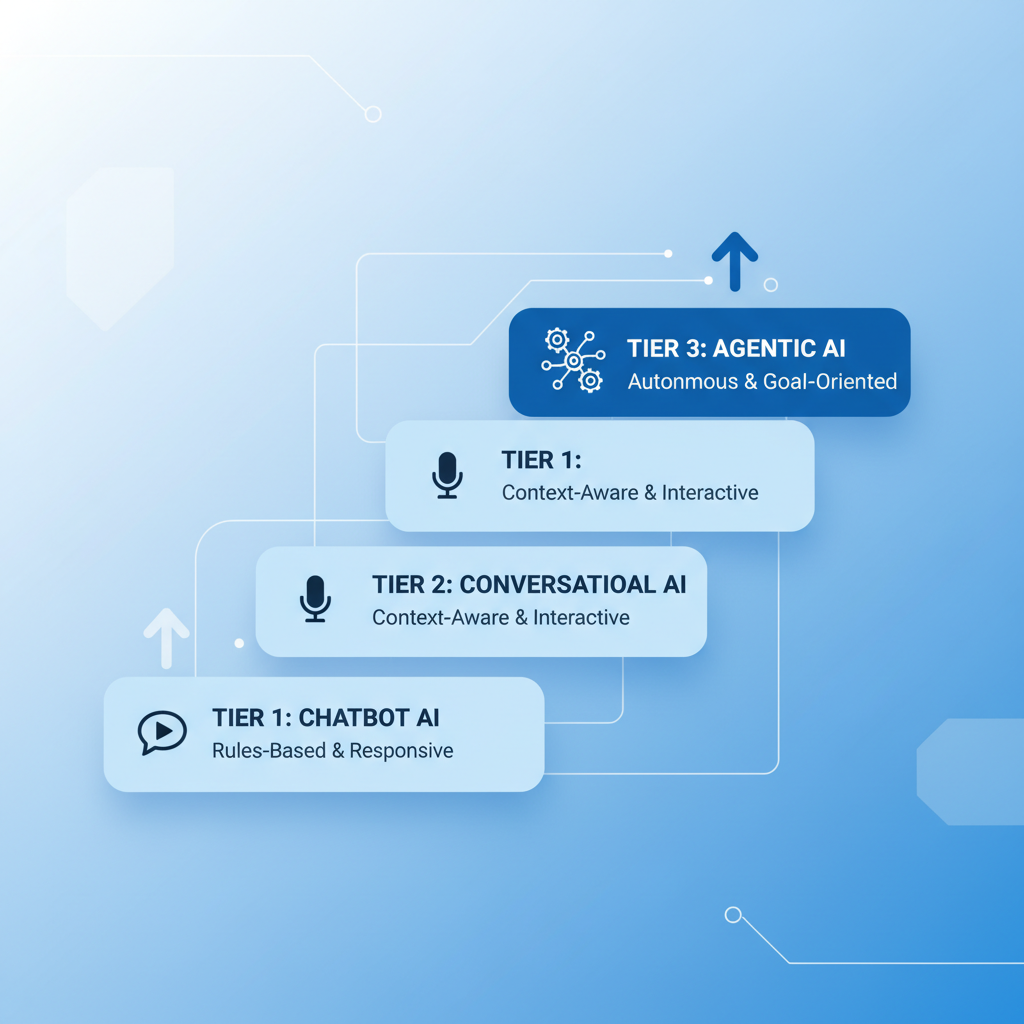
There's a lot of noise right now about AI customer support, and the terminology gets thrown around loosely. Chatbot. Conversational AI. Agentic AI. They all sound similar. They are not.
Understanding the difference isn't just an academic exercise — it directly determines whether your support experience delights customers or drives them away. Let's break it down clearly, practically, and without the jargon overload.
What Is a Traditional Chatbot?
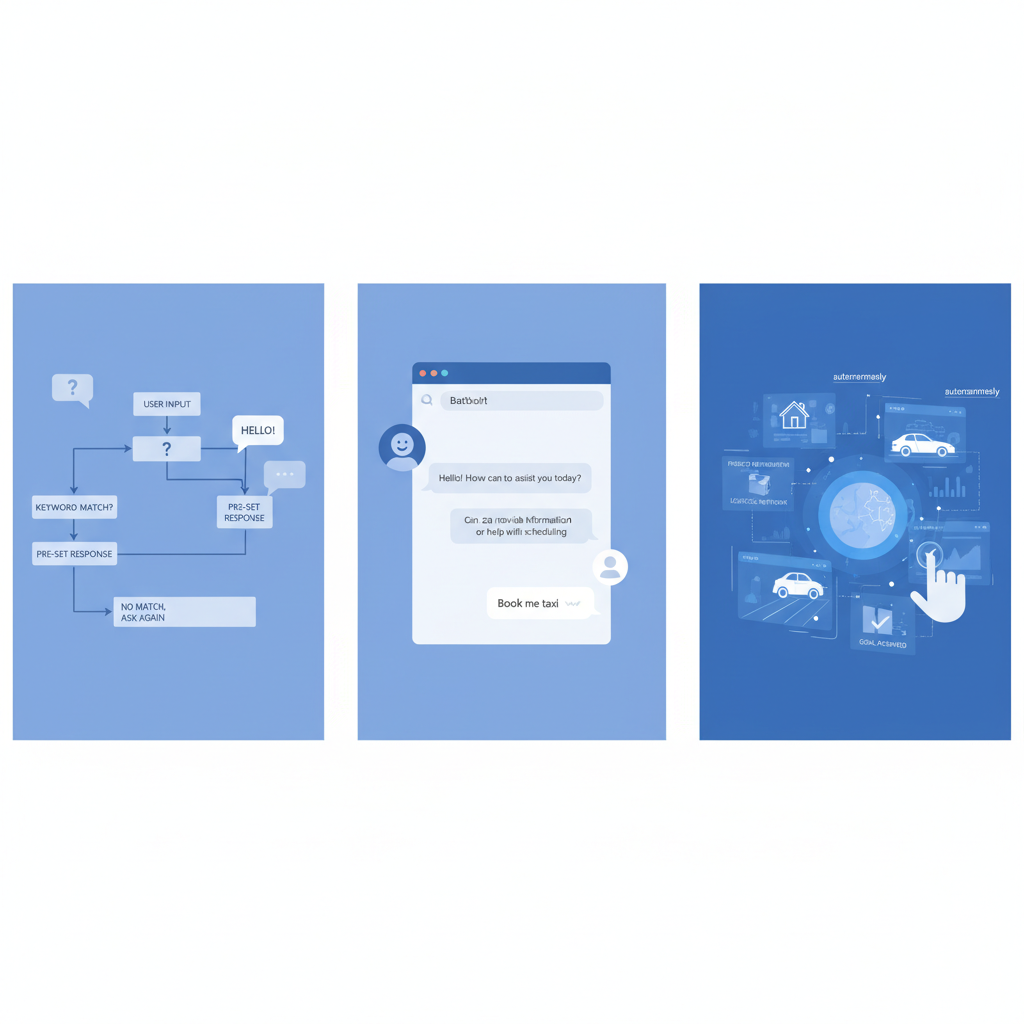
A traditional chatbot is essentially a very fancy decision tree. You click a button, it shows you options. You pick one, it shows more options. Eventually — hopefully — you land on an answer.
Think of it like an automated phone menu. "Press 1 for billing. Press 2 for technical support." It works, technically. But it's rigid, frustrating, and completely unable to handle anything it wasn't explicitly programmed for.
Key traits of traditional chatbots:
- Rule-based logic (if this, then that)
- No real language understanding — just keyword matching
- Can't handle unexpected questions or phrasing
- Requires constant manual updates when products or policies change
- Zero memory between conversations
These bots were fine in 2015. In 2026, customers expect better — and frankly, they deserve better.
What Is Conversational AI?
Conversational AI is a meaningful step forward. This is where natural language processing (NLP) and machine learning come in. Instead of forcing customers to pick from a menu, conversational AI can actually understand what someone is saying — even with typos, slang, or unusual phrasing.
Ask a conversational AI "hey, where's my stuff?" and it understands you're asking about an order. That's a big deal compared to keyword-matching bots.
Conversational AI can:
- Understand natural language input
- Maintain context within a single conversation
- Handle a broader range of topics
- Learn and improve over time with training data
But here's the catch: conversational AI is still mostly reactive. It understands your question and gives you an answer. What it generally can't do is take action on your behalf. It can tell you your order is delayed. It can't actually reroute the shipment, apply a discount code, or book you a replacement call — not without a human stepping in.
That's the ceiling of conversational AI. And for many businesses, that ceiling becomes a wall.
What Is Agentic AI? (And Why It Changes Everything)
This is where things get genuinely exciting.
Agentic AI doesn't just understand your question and respond. It decides what to do next, takes action, uses tools, and sees the task through to completion — autonomously.
The word "agentic" comes from "agency" — the ability to act independently toward a goal. An agentic AI doesn't wait to be told exactly what to do at every step. It reasons, plans, and executes.
Here's a real-world example. A customer messages your store:
"I ordered the blue sneakers last week but they haven't arrived and I have an event this weekend. Can you help?"
A traditional chatbot: Shows a link to your FAQ.
Conversational AI: Explains that shipping takes 5-7 business days.
Agentic AI: Looks up the order, sees it's delayed, applies a priority shipping coupon, sends a confirmation email, and offers to book a callback with a support agent — all in one conversation, without a human touching it.
That's not hypothetical. That's what agentic AI is built to do.

What makes AI truly "agentic":
- Tool use — it can call APIs, search databases, trigger actions
- Autonomous decision-making — it chooses which tool to use based on context
- Multi-step reasoning — it can chain actions together to solve complex problems
- Goal orientation — it works toward a resolution, not just a response
This distinction matters enormously for e-commerce AI, where a support interaction often involves checking inventory, applying discounts, updating orders, and sending follow-ups — all in one flow.
A Side-by-Side Comparison
| Feature | Traditional Chatbot | Conversational AI | Agentic AI |
|---|---|---|---|
| Understands natural language | ❌ | ✅ | ✅ |
| Maintains conversation context | ❌ | ✅ | ✅ |
| Takes real actions (orders, coupons, etc.) | ❌ | ❌ | ✅ |
| Uses multiple tools autonomously | ❌ | ❌ | ✅ |
| Hands off to human when needed | ❌ | Sometimes | ✅ |
| Learns from conversation flow | ❌ | Partially | ✅ |
Why This Matters for Small and Medium Businesses
If you're running an e-commerce store, a service business, or any customer-facing operation, here's the honest truth: your customers don't care about AI terminology. They care about getting help — fast, accurately, and without being bounced around.
Traditional chatbots often create more tickets than they close. Conversational AI reduces the frustration but still leaves action items for your human team. Agentic AI, when implemented well, can resolve the majority of support requests end-to-end without a single human touch.
For a small team, that's not a nice-to-have. That's a lifeline.
The good news is that agentic AI customer support is no longer reserved for enterprise companies with massive tech budgets. Platforms are making it accessible — deployable on WordPress sites, WooCommerce stores, and beyond — with no engineering team required.
How to Know Which One You Actually Have
Not sure where your current setup falls? Ask yourself these questions:
- Can it understand a question phrased in multiple different ways? If not, it's a traditional chatbot.
- Can it look up a specific customer's order and tell them the status in real time? If not, it's conversational AI at best.
- Can it apply a discount, book a meeting, send an email, and hand off to a human — all within one conversation — without you setting up a rigid flow? If yes, you've got agentic AI.
Most businesses, when they honestly audit their setup, discover they're running a glorified FAQ bot and calling it AI. There's no shame in it — but there is a better path.

Making the Move to Agentic AI: Practical First Steps
If you're ready to upgrade from a basic chatbot to something that actually does things, here's where to start:
- Audit your top 20 support tickets — what are customers actually asking? Can your current bot resolve any of them end-to-end?
- Identify the action gaps — where does your bot hand off to a human unnecessarily? Those are automation opportunities.
- Look for platforms with native integrations — if you're on WooCommerce or WordPress, you want AI that connects directly to your orders, products, and coupons without custom development.
- Test before you deploy — any serious agentic AI platform should let you run it through its paces in a sandbox before it goes live.
- Start with your highest-volume queries — don't try to automate everything at once. Pick the top three and nail those first.
FAQ
What's the simplest way to explain the difference between a chatbot and agentic AI?
A chatbot answers questions. Agentic AI answers questions and then does something about it. A chatbot tells you your order is delayed. An agentic AI tells you it's delayed, applies a 10% apology discount, and books you a callback — all on its own.
Is conversational AI the same as a large language model (LLM)?
Not exactly. An LLM (like GPT) is the underlying engine that enables language understanding. Conversational AI typically refers to an application built on top of an LLM for dialogue purposes. Agentic AI goes further — it gives that LLM the ability to use tools, access real data, and take autonomous action in the real world.
Can a small business actually afford agentic AI customer support?
Absolutely — and the ROI case is strong. When an AI agent handles 70-80% of your support volume autonomously, the cost savings on human support hours far outweigh the platform cost. Many agentic AI platforms, including Ruma AI, offer plans starting from $19/month, with a free tier to get started. That's not an enterprise price tag.
The Bottom Line
The gap between a basic chatbot and a true agentic AI isn't cosmetic — it's fundamental. One reads a script. The other thinks, decides, and acts.
If you're serious about delivering great customer experiences at scale — without burning out your support team — the direction is clear. Agentic AI isn't the future anymore. It's the present, and businesses that understand the difference are already pulling ahead.
If you're on WordPress or WooCommerce and want to see what agentic AI actually looks like in practice, Ruma AI is worth exploring. The WordPress AI Plugin installs in one click, connects directly to your store, and lets you test everything in a playground before going live. You can start free with 100 messages a month — no credit card, no engineering team, no decision trees to build.
Just AI that actually does the job.