
That "Chatbot" on Your Website Might Not Be What You Think
Here's a stat that should make you pause: 72% of customers who have a bad experience with a business's chat support say they won't return. And yet, most businesses are still running the same rule-based chatbot technology they deployed five years ago — slapping an "AI-powered" label on it and calling it a day.
The problem? Not all AI customer support is created equal. There's a massive difference between a chatbot that says "I didn't understand that, please choose an option below" and an autonomous AI agent that tracks your order, applies a discount code, and books a callback — all in one conversation.
If you're evaluating support tools for your business, you need to understand three distinct categories: traditional chatbots, conversational AI, and agentic AI. Let's break them down honestly.
What Is a Traditional Chatbot?
A traditional chatbot is essentially a decision tree dressed up in a chat window. You've definitely encountered one — probably got frustrated by one.
They work like this: a developer pre-programs a set of rules. If the customer types "refund," show menu option A. If they click "order status," ask for an order number, then display a canned response. There's no real understanding happening. It's pattern matching, nothing more.
What traditional chatbots are good at:- Answering the same three questions on repeat (hours, location, basic FAQs)
- Routing customers to the right department
- Collecting an email before a human takes over
- Anything outside the script
- Multi-step requests ("I want to change my order AND apply a coupon")
- Natural language — typos, slang, non-English speakers
- Any conversation that requires context or memory
The dirty secret of traditional chatbots? They often increase customer frustration rather than reduce it. Customers feel like they're being bounced around a phone menu from 2003 — just with a friendlier font.
What Is Conversational AI?
Conversational AI is a meaningful step forward. It uses natural language processing (NLP) and machine learning to actually understand what a customer is saying — not just match keywords to a script.
Think of it this way: a traditional chatbot hears the word "broken" and panics. Conversational AI understands that "my package is totally wrecked" and "the item arrived damaged" mean the same thing, and responds accordingly.
This category includes most modern AI chatbot platforms and virtual assistants. They can handle free-form questions, maintain context within a conversation, and feel genuinely human in many situations.
What conversational AI does well:- Natural back-and-forth dialogue
- Understanding intent, not just keywords
- Handling variations in how questions are phrased
- Supporting multiple languages
- Remembering context within a session
Here's the honest limitation: conversational AI is still largely reactive. It understands your customer beautifully — but then it tells them something. It doesn't do anything. It can tell a customer their order is delayed, but it can't rebook their delivery, apply a goodwill coupon, and log the complaint in your CRM. That gap? That's where most businesses are stuck right now.
What Is Agentic AI? (And Why It Changes Everything)
Agentic AI is the category that's redefining what customer support automation can actually look like in 2026.
The word "agentic" comes from agency — the ability to take independent action toward a goal. An agentic AI doesn't just understand your customer. It decides what needs to happen, picks the right tools to make it happen, and executes — autonomously.
Imagine a customer messages your WooCommerce store at 11pm on a Sunday:
"Hey, I placed an order yesterday but I think I entered the wrong address. Also, do you have a discount for returning customers?"A traditional chatbot: "Please contact us during business hours."
A conversational AI: "I understand you have a concern about your order address and are asking about discounts. Please contact our support team."
An agentic AI: Pulls up the order, checks if it's still modifiable, updates the shipping address, searches for an applicable returning-customer coupon, applies it to the account, and sends a confirmation — all without a human touching it.
That's not a hypothetical. That's what agentic AI is doing for businesses right now.

How Agentic AI Actually Works
Under the hood, agentic AI operates through a reasoning loop:
This is fundamentally different from conversational AI, which stops at step one. The "agentic" part is steps two through four.
The Practical Difference for Your Business
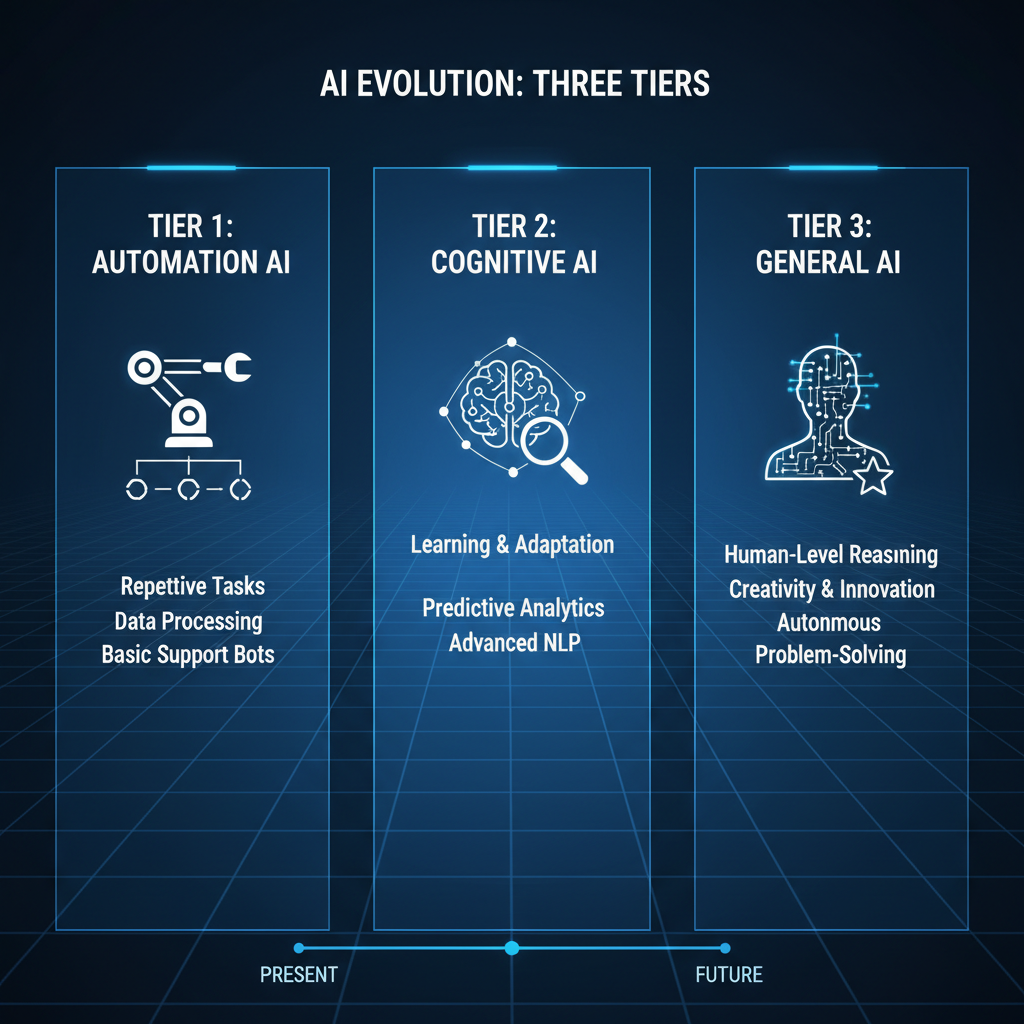
Let's make this concrete. Here's how the three tiers stack up across common business scenarios:
| Scenario | Traditional Chatbot | Conversational AI | Agentic AI |
|---|---|---|---|
| "Where's my order?" | Shows FAQ link | Explains tracking process | Pulls live order data and shows status |
| "Apply a discount for me" | Asks you to call | Explains how coupons work | Finds and applies the best coupon |
| "Book a demo" | Shows contact page | Collects details, emails team | Books directly on your calendar |
| "I want to speak to someone" | Displays phone number | Acknowledges and provides contact | Initiates live handoff or voice call |
| New lead from chat | Lost unless human grabs it | Collected if programmed | Auto-pushed to HubSpot, Salesforce, or Zoho |
The ROI difference is stark. Conversational AI reduces ticket volume. Agentic AI eliminates it.
Why Most "AI Chatbots" Are Still Stuck in Tier Two
Here's what the marketing doesn't tell you: a lot of tools that claim to offer "AI-powered" support are really just conversational AI with a thin wrapper. They understand your customers well. But when it comes to taking action — tracking orders, modifying carts, syncing to your CRM, calling customers back — they hand off to a human or hit a wall.
True agentic AI requires deep integrations. It needs to reach into your e-commerce platform, your CRM, your calendar, your coupon engine. It needs to do things, not just say things. That's a much harder technical problem to solve, which is why most platforms haven't cracked it yet.
If you're running a WordPress or WooCommerce store, this matters enormously. You need an AI that doesn't just chat — it acts. Read more on our blog about how agentic AI is reshaping support for online stores.
How to Choose the Right Tier for Your Business
Not every business needs agentic AI on day one. Here's a quick framework:
You're fine with a traditional chatbot if:- You get fewer than 20 support queries a week
- Your questions are 100% predictable and repetitive
- You have a dedicated support team that handles everything else
- You're getting volume that's hard to manage manually
- Your customers ask questions in different ways
- You serve customers in multiple languages
- You run an e-commerce store with order, product, and coupon complexity
- Support is eating into your team's time for non-complex tasks
- You want your AI to actually resolve issues, not just acknowledge them
- You're generating leads and need them captured and synced automatically

The Bottom Line
The terminology gap in this industry is real, and it costs businesses money. When you think you're buying "AI customer support" but you're actually getting a glorified FAQ widget, you end up with frustrated customers and a support team that's just as overloaded as before.
The shift from chatbot → conversational AI → agentic AI isn't just a technology upgrade. It's a fundamental change in what's possible. Agentic AI doesn't just talk to your customers — it works for them.
If you're ready to move beyond chatbots and put a genuinely autonomous AI agent to work on your website, Ruma AI is built exactly for that. It's an agentic AI platform with 13 built-in tools — from order tracking and coupon application to voice calling and CRM sync — that deploys on WordPress in one click. You can start free with 100 messages a month, or view pricing to find a plan that fits your business.
Your customers deserve an AI that actually does something. Now you know the difference.
Frequently Asked Questions
What is the difference between a chatbot and conversational AI?
A traditional chatbot follows a pre-programmed script and matches keywords to canned responses. Conversational AI uses natural language processing to genuinely understand what a customer is asking — including variations in phrasing, intent, and context — and responds in a more natural, human-like way. Conversational AI is significantly more flexible and handles unpredictable questions far better than rule-based chatbots.
What makes agentic AI different from conversational AI?
Conversational AI understands your customers. Agentic AI understands and acts. An agentic AI autonomously decides which tools to use and takes real-world actions — like tracking an order, applying a discount, booking a meeting, or syncing a lead to your CRM — without needing a human to step in. It's the difference between an AI that talks and an AI that works.
Is agentic AI suitable for small businesses?
Absolutely. In fact, small and medium businesses often benefit the most from agentic AI because they don't have large support teams to fall back on. An agentic AI platform can handle order inquiries, lead capture, coupon management, and customer callbacks around the clock — without adding headcount. With plans starting as low as $19/month, it's accessible for businesses of almost any size.