Your AI Knows Your Return Policy — But Did You Train It?
Here's something that surprises a lot of business owners when they first set up an AI customer support system: the AI can answer detailed questions about their specific products, store policies, and order details — without anyone feeding it thousands of training examples or spending weeks fine-tuning a model.
How? The answer is a technology called Retrieval-Augmented Generation, or RAG. And if you're running a WooCommerce store, a service business, or any kind of operation where AI customer support needs to sound like it actually works for your company, understanding RAG is one of the most valuable things you can do in 2026.
Let's break it down — no PhD required.
What Is RAG? (The Plain-English Version)
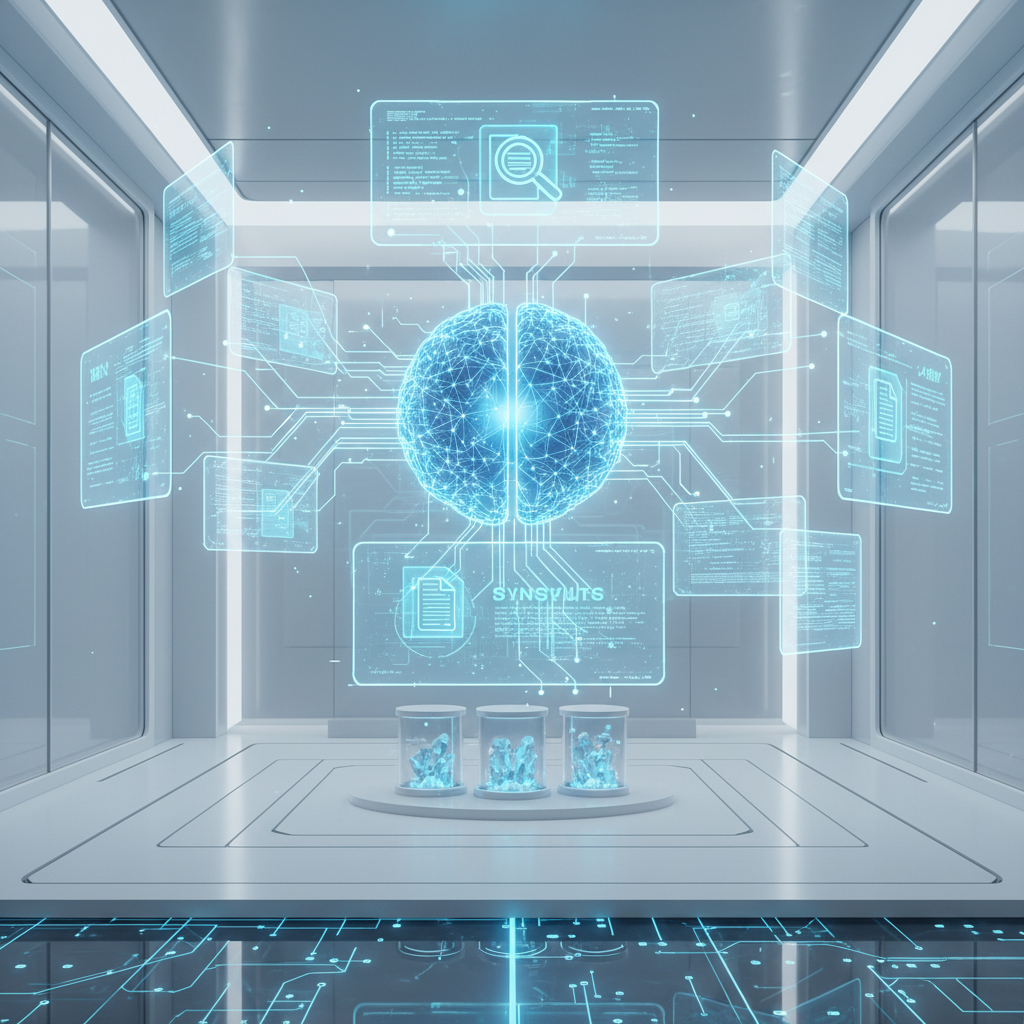
Retrieval-Augmented Generation (RAG) is an AI architecture that separates knowing things from understanding language. Instead of cramming all your business knowledge into a model during training, RAG lets the AI look things up in real time — like a brilliant employee who always has access to the right filing cabinet.Here's the simplest way to think about it:
- A traditional AI model is like a student who studied a textbook and then had the book taken away at exam time. It can only answer based on what it memorized.
- A RAG-powered AI is like an open-book exam. The model still has its reasoning and language skills, but it can also retrieve relevant documents, product data, or policies before generating a response.
The result? An AI that sounds deeply knowledgeable about your business — without your business data ever becoming part of a shared training dataset.
Why "Training Data Leaks" Are a Real Concern
Before RAG became mainstream, businesses that wanted a smart AI chatbot had two options:
Option two worked well for accuracy, but it came with a serious risk: once data is baked into a model's weights, it's nearly impossible to remove. There have been documented cases of fine-tuned models inadvertently leaking sensitive information when prompted cleverly — things like internal pricing logic, customer names, or confidential product details.
For a small business owner, the idea that a chatbot might accidentally quote a confidential supplier price or expose a customer's order history to someone else is genuinely alarming.
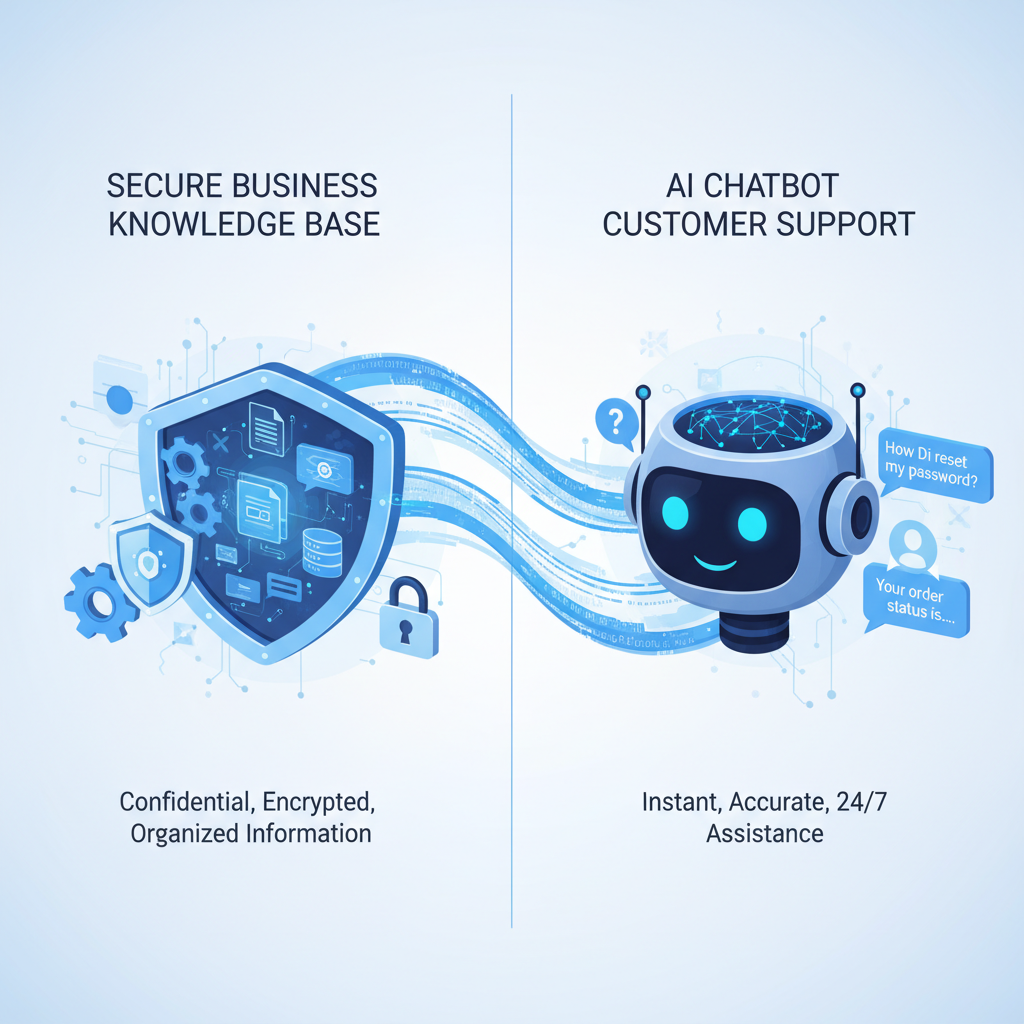
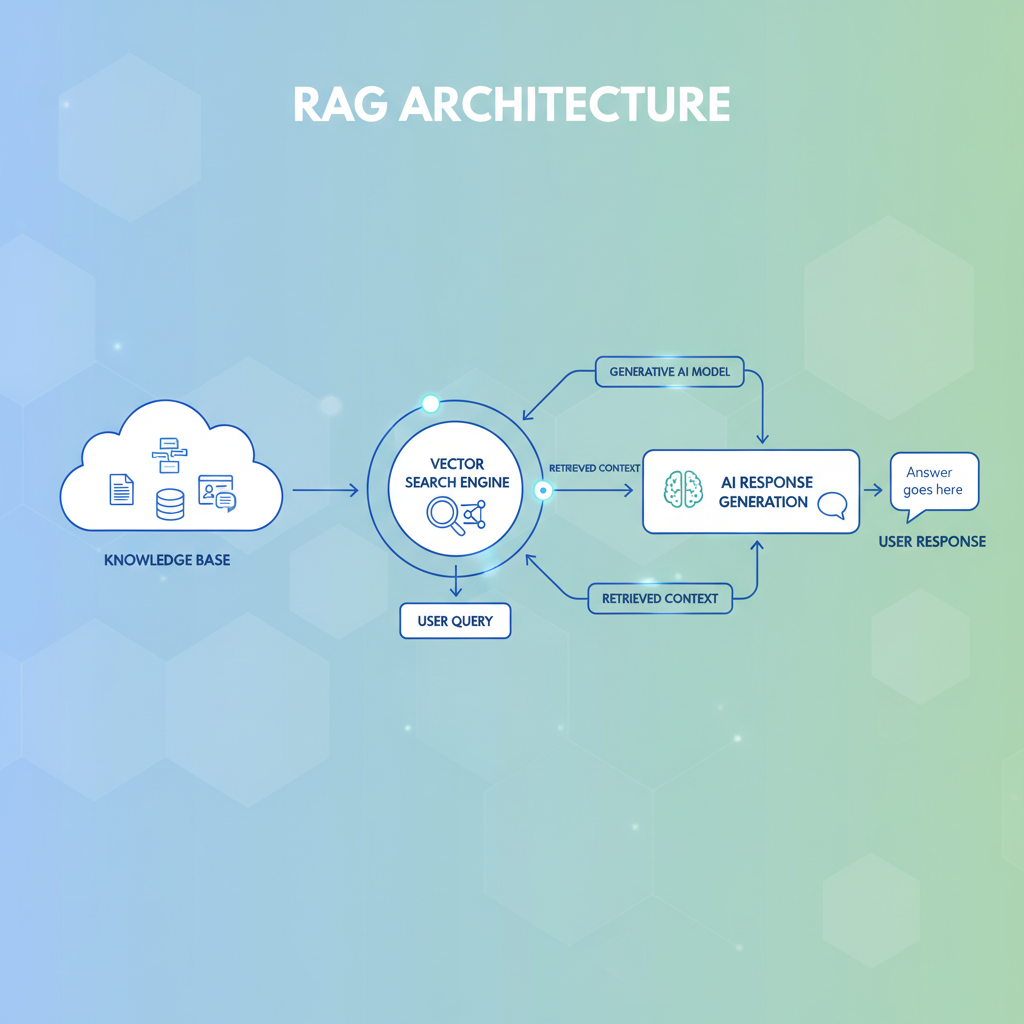
RAG sidesteps this problem entirely. Your data lives in a separate, controlled knowledge base — a vector database or document store that the AI queries on demand. The language model itself never "absorbs" your data. When you delete something from the knowledge base, it's gone. When you update a policy, the AI reflects that update immediately.
No retraining. No data entanglement. Clean separation.
How RAG Actually Works: A Step-by-Step View
Let's walk through what happens when a customer asks your AI chatbot, "Do you offer free shipping on orders over $50?"
Step 1 — The question is converted into a vector embedding. The AI transforms the customer's question into a mathematical representation that captures its meaning, not just its words. Step 2 — The system searches your knowledge base. Using that embedding, it performs a semantic search across your connected documents — your shipping policy page, FAQ, product descriptions, whatever you've connected. Step 3 — Relevant chunks are retrieved. The system pulls back the most relevant pieces of text. Not the whole document — just the paragraphs that are semantically close to the question. Step 4 — The language model generates a response. The AI receives both the original question AND the retrieved context, then generates a natural, accurate answer grounded in your actual content. Step 5 — The customer gets a precise, on-brand reply. "Yes! We offer free standard shipping on all orders over $50 within the continental US. Orders typically arrive in 3-5 business days."This whole process happens in under a second. The customer never knows it happened. But the accuracy difference between a RAG-powered response and a hallucinated one is night and day.

RAG + Agentic AI: The Next Level
RAG on its own is powerful. But when you combine it with agentic AI — AI that can take autonomous actions, not just generate text — things get genuinely interesting.
A pure RAG system retrieves information and answers questions. An agentic AI system does that and decides what to do next. It might:
- Check a live order status from your WooCommerce database
- Apply a coupon code to a customer's cart in real time
- Book a meeting, send a follow-up email, or transfer the conversation to a human agent when things get complex
This is where modern AI customer support has moved in 2026. The retrieval layer handles your static knowledge (policies, FAQs, product details). The agentic layer handles dynamic actions (orders, carts, bookings, CRM updates). Together, they create something that feels less like a chatbot and more like a knowledgeable team member who actually has system access.
The key point for business owners: you don't have to choose between data safety and capability. RAG gives you both.
Practical Tips for Using RAG Well in Your Business
If you're evaluating or setting up an AI helpdesk for your store or service business, here's what actually matters in practice:
Keep your knowledge base clean and current
RAG is only as good as what you feed it. Outdated return policies, old pricing, discontinued products — these will produce confident-sounding wrong answers. Treat your knowledge base like a live document, not a one-time upload.
Use structured data where possible
When your product catalog, FAQ, and policies are well-organized, the retrieval step is dramatically more accurate. Messy, duplicated content creates retrieval noise.
Understand what RAG doesn't solve
RAG retrieves from what you've given it. If a customer asks about something outside your knowledge base, a good agentic AI system should recognize that gap and either escalate to a human or admit uncertainty — not hallucinate an answer.
Check your retrieval logs periodically
Many platforms let you see what content was retrieved for a given question. This is gold for improving accuracy. If the wrong chunk keeps getting pulled for a common question, restructure that content.
Layer in real-time data connections
For e-commerce, your knowledge base shouldn't just be static documents. Connecting it to live WooCommerce product data, order status, and coupon availability means the AI can handle the majority of support queries without human intervention.
What This Means for Small and Medium Businesses
For a long time, genuinely intelligent AI customer support was the domain of enterprise companies with dedicated ML teams and six-figure budgets. RAG changed that calculus significantly.
Today, a WooCommerce store owner in Manchester or Melbourne can deploy an agentic AI that knows their entire product catalog, handles order inquiries, applies discount codes, and speaks 50+ languages — without a single line of custom training code and without exposing sensitive business data to a shared model.
The technology has matured to the point where the question is no longer "can small businesses afford smart AI?" It's "which platform makes it easiest to connect your knowledge and get out of the way?"
If you're running a WordPress or WooCommerce site, Ruma AI is built exactly around this architecture. The WordPress AI Plugin connects directly to your product catalog, orders, and coupons — so the AI always has live, accurate context to retrieve from. It syncs leads and transcripts to your CRM, handles voice calls, and escalates to a live agent when needed. You can test the whole thing in the playground before deploying a single line of code.
RAG isn't magic. But it is the reason AI can finally learn your business without your business becoming the training data. That's a distinction worth understanding — and worth building on.
Start free and see how it handles your actual customer questions. You might be surprised how little setup it needs.Frequently Asked Questions
What is RAG in AI, and how is it different from fine-tuning?
RAG (Retrieval-Augmented Generation) is an AI technique where the model retrieves relevant information from an external knowledge base at the time of answering, rather than having that information baked into its parameters through training. Fine-tuning embeds data into the model's weights permanently — making it difficult to update or remove. RAG keeps your data separate and queryable, which means updates take effect immediately and sensitive information is never encoded into the model itself.
Can RAG-powered AI handle real-time data like live order statuses?
Yes — when RAG is combined with agentic AI tools that connect to live systems (like a WooCommerce database), the AI can retrieve both static knowledge (policies, FAQs) and dynamic data (order status, stock levels) in a single response. This is what separates a basic FAQ bot from a genuinely useful AI customer support agent.
Is RAG technology safe for businesses handling customer data?
RAG is significantly safer than traditional fine-tuning from a data privacy standpoint because your business data is never encoded into the model's weights. Your knowledge base remains under your control — you can update, restrict, or delete content at any time. That said, you should still evaluate how any platform stores and accesses your knowledge base, and ensure it complies with relevant data protection regulations like GDPR or CCPA. View pricing and plan details to understand how data is handled across different tiers.